


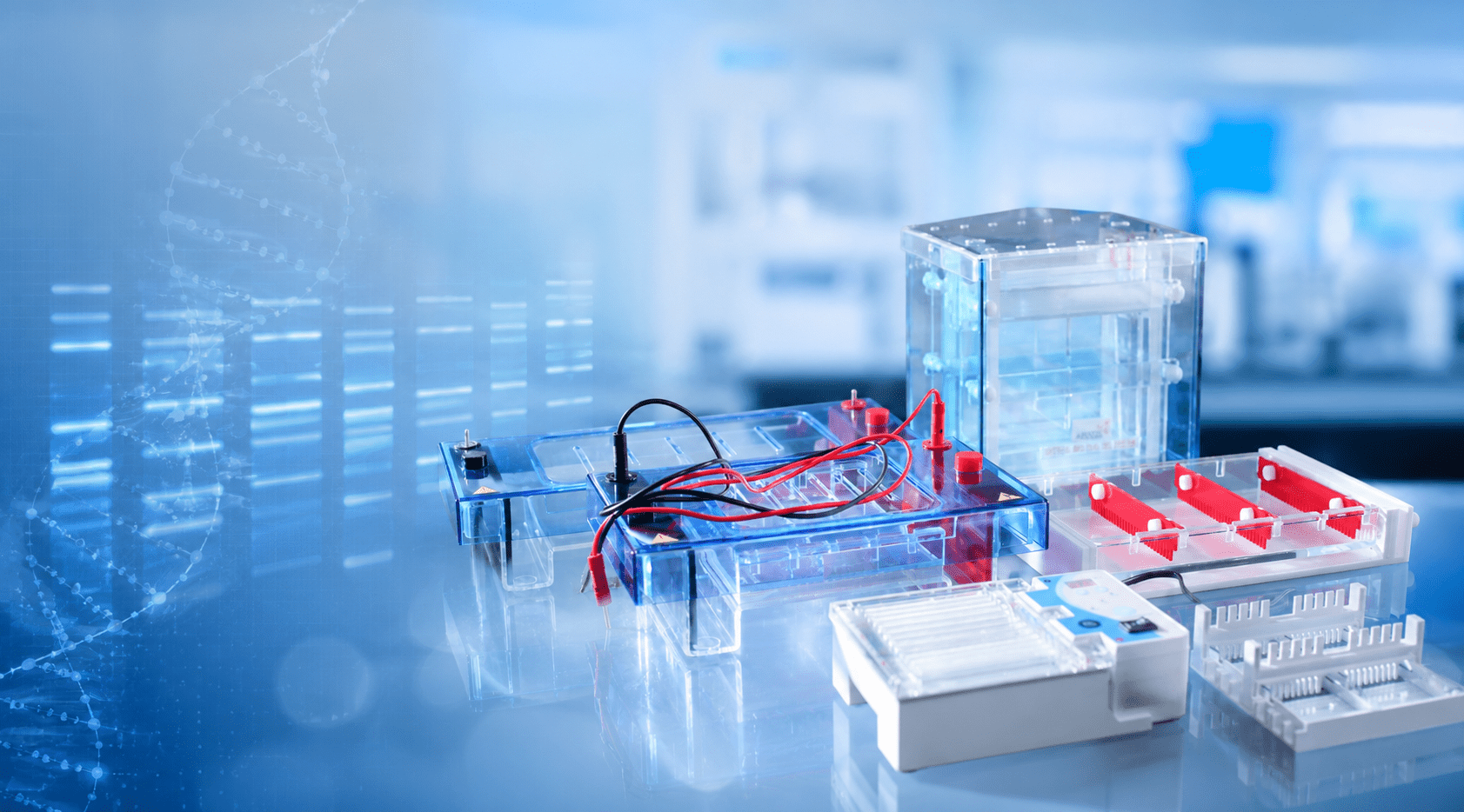

Whether identifying genetic disorders, analysing proteins, or confirming PCR products, electrophoresis has become one of the most widely used techniques in molecular biology. Its ability to separate DNA, RNA, and proteins with remarkable precision makes it indispensable in research, biotechnology, and pharmaceutical laboratories allowing researchers to analyse the building blocks of life and diagnose genetic disorders.
This technique separates charged biomolecules such as DNA, RNA, and proteins according to their size, charge, and molecular conformation. During electrophoresis, molecules migrate through a porous gel matrix. DNA and RNA naturally possess a negative charge due to their phosphate backbone while Proteins require SDS in SDS-PAGE to obtain a uniform negative charge. The negatively charged molecules move towards the positive electrode, and the positively charged molecules move toward the negative electrode and how far and how fast they travel depends on their size, shape, and overall charge. The smaller molecules migrate through gel matrix faster while the larger molecules move slow and mostly remain close to the starting point allowing researcher to distinguish between different molecules.
Factors affecting separation:
- Molecular Size and Shape: Smaller molecules migrate through the gel matrix more rapidly than larger molecules as they encounter less resistance.
- Net charge on the molecule: Molecules move fast depending on the attraction towards electrode with the opposite charge.
- Strength of the electric field: Voltage creates an electric field, and that drive the molecules move through the gel.
- Ionic strength of the buffer: Buffer ionic strength determines electrical conductivity. Excessively high ionic strength may generate heat, while insufficient ionic strength can reduce separation efficiency.
- Properties of the supporting medium: Pore size mostly depends on the concentration of gel, if the gel is highly concentrated, the pore size will be smaller while the less concentrated gel will have large pore size, and the small molecules can move easily.
- Temperature: Excessive heat may cause band distortion, or gel damage, reducing separation quality.
- Quality of equipment: consistent, reliable hardware is critical for reproducible results
Types of Electrophoresis:
Not all electrophoresis is same. The two most used electrophoresis systems are horizontal and vertical electrophoresis; each designed for different analytical applications.
Horizontal Electrophoresis is commonly used to separate out the DNA & RNA molecules, specifically agarose gel is used as the medium. Th gel is placed horizontally in a buffer filled tank. This method is generally used by molecular biology labs for the routine gel electrophoresis. Offers lower resolution compared to vertical systems. Abdos offers a different design in electrophoresis for the wide range of applications.
Vertical Electrophoresis (PAGE/SDS-PAGE) is an essential tool for protein separation based on their molecular weight later use in downstream applications such as western blotting. The gel that is used to separate protein is Sodium Dodecyl Sulfate Polyacrylamide Gel that run in vertical direction between two glass plates. It is designed specifically for protein analysis and the separation of smaller DNA fragments, delivering higher resolution.
Modern Electrophoresis Systems Improve Laboratory Efficiency
After understanding the basic principles of electrophoresis, selecting the right equipment becomes equally important. Modern systems are designed to reduce setup time, improve reproducibility, and minimize user error.
Abdos’s introduces CompactPAGE mini moulded vertical electrophoresis system, this unit is specifically designed for both gel casting and running in the same tank that saves times and reduces handling errors.
Single-Moulded Construction: The tank is manufactured as a single integrated unit rather than multiple assembled components. This design improves durability, minimizes leakage risk, and enhances long-term reliability.
Screw-Free Assembly for Faster Operation: Traditional electrophoresis systems often require screws and clamps to assemble gel cassettes. CompactPAGE eliminates this inconvenience through a screw-free locking mechanism. Researchers can quickly assemble the gel cassette, create a secure seal, and begin experiments with minimal effort. This not only saves time but also reduces the possibility of assembly errors.
Designed for Safety and Reliability: The casting frame is engineered to hold glass plates securely while distributing pressure evenly. This minimizes stress on the glass and significantly reduces the risk of accidental breakage during gel preparation and operation.
From Gel to Membrane: Western Blotting
Protein separation is often only the first step in analysis. For protein identification, researchers typically transfer the separated proteins onto a membrane using Western blotting. The membrane is then blocked to prevent non-specific binding, probed with primary and secondary antibodies, and finally visualized using chemiluminescence, fluorescence, or colorimetric detection.
Abdos introduces CompactBLOT a mini moulded wet blotting transfer system are designed to integrate seamlessly with vertical electrophoresis units, allowing the same tank to serve both functions and enabling the transfer of two gels simultaneously.
To conclude
Electrophoresis remains one of the most fundamental analytical techniques in life science. From quality control in biopharmaceutical manufacturing to forensic DNA profiling, electrophoresis has become a cornerstone of life science research. Its ability to resolve complex mixtures of biomolecules with precision and reproducibility makes it irreplaceable. As equipment continues to evolve becoming more compact, user-friendly, and efficient electrophoresis remains at the heart of advancing science.
Interested in learning more? Explore our complete range of electrophoresis and life science laboratory solutions at www.abdoslifesciences.com
Reference: https://www.ncbi.nlm.nih.gov/books/NBK585057/
FAQs:
- Why do smaller molecules move faster during electrophoresis?
The gel acts like a molecular sieve. Smaller molecules pass through its pores more easily, encountering less resistance, while larger molecules move more slowly because they experience greater friction within the gel matrix.
- What is the difference between agarose gel electrophoresis and PAGE?
Agarose gel electrophoresis is primarily used for separating DNA and RNA fragments and is commonly performed in horizontal systems. Polyacrylamide gel electrophoresis (PAGE), including SDS-PAGE, provides much higher resolution and is mainly used for protein analysis or separating very small DNA fragments.
- What is the difference between horizontal and vertical electrophoresis?
Horizontal electrophoresis is commonly used with agarose gels for DNA and RNA analysis. It is simple, cost-effective, and ideal for routine molecular biology applications.
Vertical electrophoresis uses polyacrylamide gels and is preferred for protein analysis because it offers superior resolution, especially for proteins and small nucleic acid fragments
- What advantages do integrated gel casting and running systems offer?
Integrated systems allow researchers to cast and run gels in the same unit, reducing handling steps, minimizing the risk of gel damage, shortening preparation time, and improving experimental reproducibility.