



PET & PETG Media Bottles: Preferred Choice for Cell Culture and Media Storage
By: Abdos LifeSciences
In modern life science laboratories, media bottles are used constantly to prepare, store, transport, and dispense cell culture media, buffers, sera, reagents, and other laboratory solutions. Traditional glass bottles come with certain challenges, such as high risk of breakage, hand fatigue and repeated autoclaving causes microfractures that leads to the unpredictable failure of experiment. To overcomes these challenges laboratories switched to Polyethylene Terephthalate (PET) and Polyethylene Terephthalate Glycol-modified (PETG) media bottles that provides excellent optical clarity, chemical safety and making them highly durable and sustainable.
In this blog, we will deeply understand how laboratories can select and use the right bottle for their specific application using PET & PETG Media Bottle range (1, 2).
Understanding the Materials: What is PET and PETG?
PET and PETG both belong to the polyester family of thermoplastics, but they are chemically modified in different ways to serve different laboratory needs.
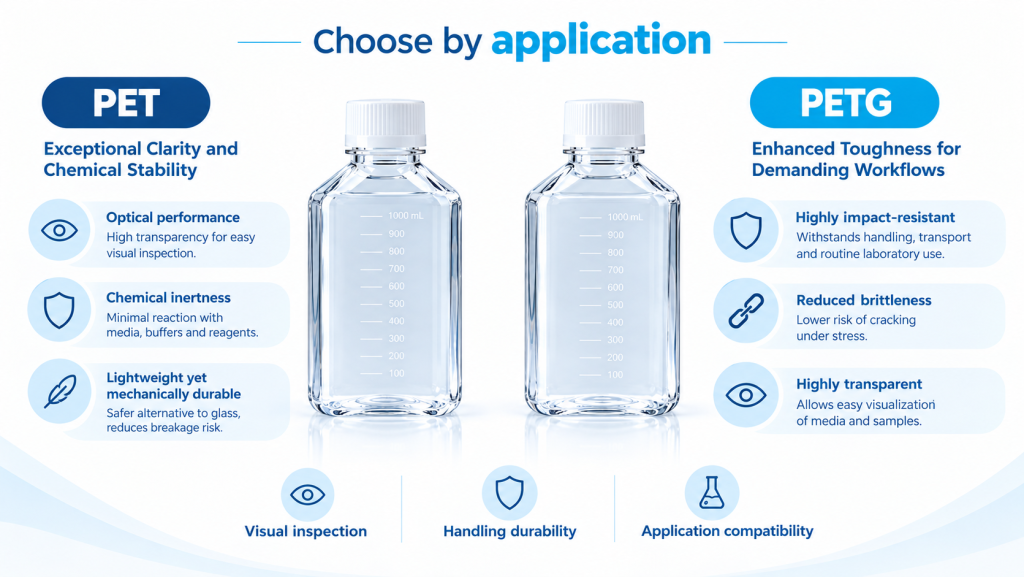
PET: Exceptional Clarity and Chemical Stability- PET (Polyethylene Terephthalate) is primarily prioritised for different reasons:
- Optical performance prized in laboratory settings for its high transparency that allows researchers to visually inspect media for turbidity, precipitation or crystallization of dissolved components, color changes that may indicate pH shifts, degradation, or oxidation and general consistency and homogeneity of the solution. All of this can be assessed without opening the bottle, which is a major advantage for maintaining sterility and reducing unnecessary handling.
- Chemical inertness: PET offers strong chemical inertness toward most aqueous solutions, means it does not react with typical culture media, buffers, and reagents and protects the integrity of stored samples which is critical requirement, when working with sensitive cell lines or precisely formulated reagents.
- Lightweight yet mechanically durable: PET is also lightweight yet mechanically durable, offering a much safer alternative to glass by significantly reducing the risk of breakage during routine handling, centrifugation prep, or transport between lab benches and storage units.
PETG: Enhanced Toughness for Demanding Workflows
PETG (polyethylene terephthalate glycol-modified) is a glycol-modified form of polyethylene terephthalate (PET). The modification alters the polymer structure and can improve properties such as toughness, impact resistance and processability while retaining high optical clarity
- Highly impact-resistant: PETG offers high toughness and resistance to impact, helping reduce the likelihood of cracking or breakage during routine laboratory handling and transport.
- Reduced brittleness: Glycol modified PETG reduces the chance of polymer to crack under stress where large number of samples are processed in a short period that matters enormously in high-throughput or high-turnover environments.
- Highly transparent: Allows researchers for easy visualization of media, samples, and reagent levels without sacrificing durability.
- Gas-barrier properties: PETG containers can provide effective resistance to the permeation of gases such as oxygen and carbon dioxide, helping limit gas exchange through the container wall and supporting the stability of formulations where gas exposure is a concern.
All these combinations made PET & PETG especially valuable in various applications such as:
- Cell Culture Media preparation and storage: Using PET media bottles researcher can visually view the media. Their transparency allows visual inspection of the contents for changes such as turbidity, precipitation or crystal formation. For sensitive cell-culture applications, the suitability of the container should be established through appropriate compatibility and extractables/leachable evaluation.
- Sera and Oxidation-Sensitive biologics storage: Serum and other biologically active supplements are sensitive to oxidative degradation. Dissolved oxygen enters through a container wall over weeks of storage, degrading labile proteins and growth factors. This problem is specifically solved with the PETG’s gas-barrier property, where its modified polymer structure restricts gas exchange across the bottle wall more effectively than standard PET, helping maintain the biochemical stability of sensitive formulations over extended storage periods.
- Buffers and general aqueous reagents: Buffer and general aqueous reagents are typically used in the laboratory for the routine experiments in higher frequency. The researcher requires the bottle material not to react with solution stored even after long period and PET provides the high chemical stability that prevents the buffer and general aqueous reagents to react with the stored solution. However, compatibility should always be evaluated against the specific chemical composition, concentration, temperature and storage duration of the formulation
- Bioprocessing and Pharmaceutical manufacturing: The QC environments require repeated mechanical use and the glycol modification in PETG increases impact resistance. These containers are used in bioprocessing and pharmaceutical workflows because of their durability, clarity, low weight and suitability for storage and transport of certain process materials. For regulated applications, the specific container system should be selected based on its applicable regulatory, particulate, sterility, extractables/leachable and compatibility requirements (3).
- Shipping and transport of prepared media: When prepared media or samples move between facilities, the mechanical stress during transit like vibration, impact, and temperature fluctuation becomes the dominant risk factor rather than chemical compatibility. PETG’s impact resistance is specifically relevant here. Its resistance to impact can help reduce the risk of container damage during routine handling and transit.
PET and PETG’s lower weight relative to glass also reduces shipping costs and physical strain during manual transport, a practical benefit that compounds across high sample volumes.
Choosing Between PET and PETG by Application
| Solicitud | Primary Driver | Recommended Material |
| Cell culture media prep/storage | Optical clarity, container compatibility, and low extractables. | PET |
| Sera / sensitive biologics storage | Gas-barrier properties and container/formulation compatibility | PETG |
| General buffers and reagents | Compatibility with the specific aqueous formulation | PET |
| Bioprocessing / pharma QC | Application-specific biocompatibility, extractables/leachable, cleanliness, and mechanical durability | PETG |
| Shipping / transport | Impact resistance during transit | PETG |
| High-throughput workflows | Durability and handling efficiency for frequent handling | PETG |
Conclusion
The choice between PET and PETG isn’t about one material being universally superior, they share several laboratory applications. PET’s clarity and inertness make it the practical choice for routine media and reagent storage when visual monitoring matters most. PETG’s added toughness and gas-barrier performance make it the better fit wherever mechanical stress, transport, or long-term biologic stability are the deciding factors. The appropriate material should ultimately be selected based on the formulation, storage conditions, container design and application-specific compatibility and extractables/leachables requirements.
Abdos’s PET and PETG media bottle range is built around this distinction, giving laboratories the flexibility to select the right vessel for each stage of their workflow, from routine cell culture to demanding bioprocessing and pharmaceutical environments. Check out the Abdos complete Media Bottle range at Media Bottles | PETG Bottles | PET Bottles | Media Bottles PETG | Square Bottles
Referencias
- https://doi.org/10.1177/0307174X1504200709
- Jenke, D. R. (2005). Linking extractables and leachables in container/closure applications. PDA Journal of Pharmaceutical Science and Technology, 59(4), 265–281.
Frequently Asked Questions (FAQ’s)
- What is the main difference between PET and PETG?
PET is more rigid and suited for routine storage, while PETG is more flexible and impact resistant for demanding handling and transport. - When should I choose PET?
PET is ideal for culture media, buffers, and general reagents where clarity, chemical stability, and rigidity are the main requirements. - When should I choose PETG?
PETG is preferred for frequent handling, transportation, bioprocessing, and pharmaceutical QC, where greater impact resistance and durability are important. - Are PET and PETG suitable for long-term storage?
Yes, both can be used for long-term storage, but the choice should depend on the specific formulation, storage conditions, and application requirements. - What sizes are available in the Abdos range?
Abdos PET and PETG Media Bottles are available in 60, 125, 250, 500, and 1000 mL, in sterile and non-sterile formats.