


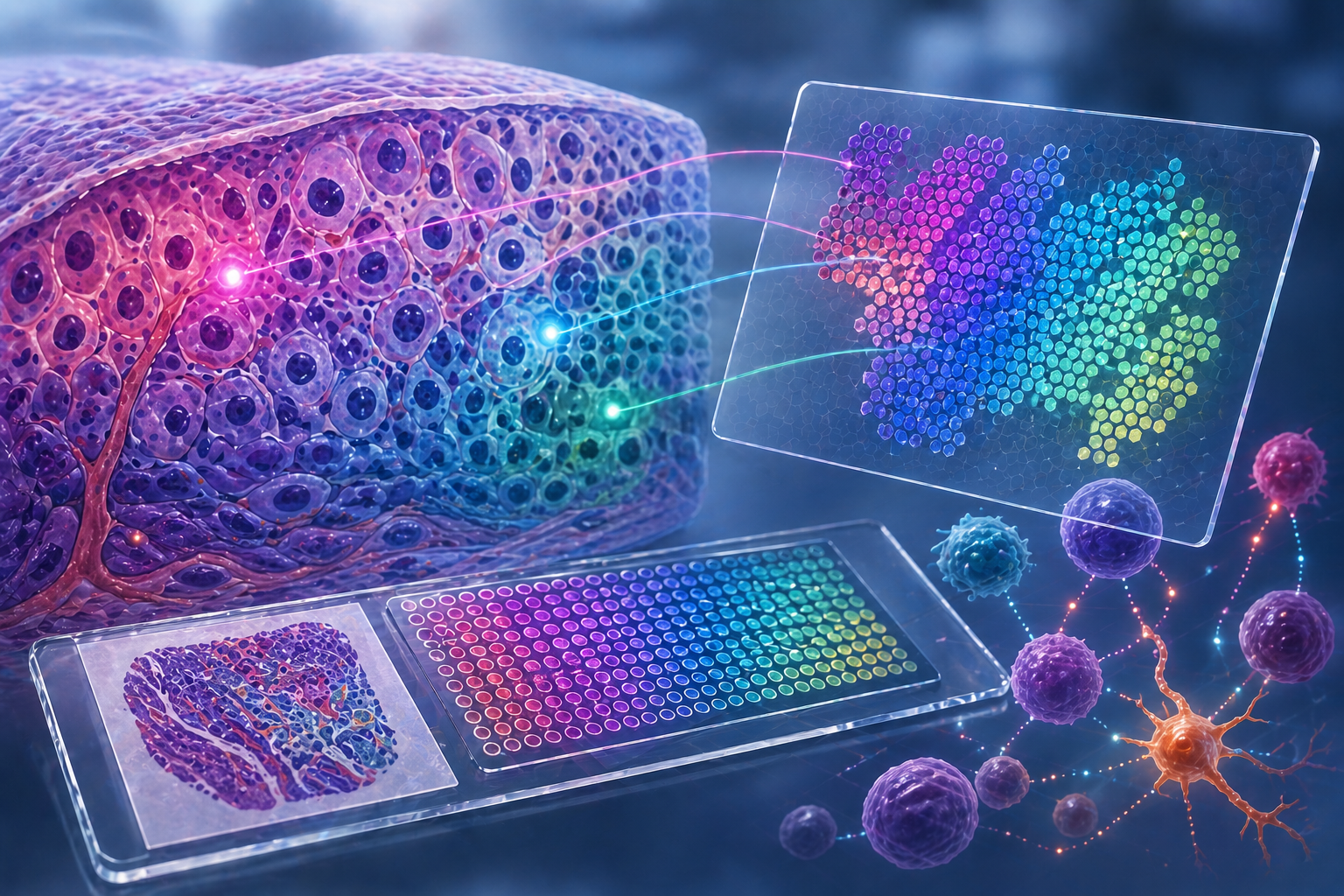

Modern biology largely relies on an understanding of gene expression. To study thousands of genes, researchers traditionally use genomic techniques that involve extracting RNA from cells, since RNA is found inside them.
However, during RNA extraction, cells are removed from tissues and often mixed. This process leads to the loss of a critical piece of information about their location, where exactly genes are being expressed within the tissue. In the human body, cells are arranged in specific patterns, and their behaviour depends on their position, interactions with nearby cells, and the surrounding environment. Two cells located in different places can behave differently even though they have the same genes. Thus, spatial transcriptomics came into existence to help explain these differences by linking gene activity to physical position.
How spatial transcriptomics helps identify gene expression in tissues?
Spatial Transcriptomics, a technology used by researchers to identify gene expression of cells or tissues to find out the active genes and their exact location in the tissue. Scientists use histological techniques to process the tissue, while RNA Sequencing technology helps in the mapping of gene expression across millions of genes in a single run.
Using these two methods, the researcher primarily collected the RNA directly from the thin tissue section, i.e. from the exact location in the tissue, also known as the spatial position, which is further sequenced to identify active genes in specific regions of the tissue and in studying the interaction between neighbouring cells.
This method gives a new way to study gene expression, and helps in
- Identifying different cell types
- Discovering region-specific gene activity
- Studying interactions between the neighbouring cells
Thus, provides a powerful way to understand how gene expression varies across healthy and diseased conditions.
Types of Spatial Transcriptomics Approaches
Imaging-Based Spatial Transcriptomics: Scientists use In-situ hybridization technique to visualise RNA in a tissue section, using microscopy and fluorescent probes. Its high spatial resolution enables the visualisation of gene expression patterns at a single cell level. However, this technique can only be used to study a small number of genes at a time.
Sequencing-Based Spatial Transcriptomics: It combines spatial barcodes that bind RNA from slices of tissue, with RNA sequencing, to allow the expression levels of thousands of genes to be measured over the entirety of a tissue sample. It has a less precise spatial resolution than some imaging-based techniques, but a broader range of genes could be covered. (1)(2)
| Different Features | Imaging-Based ST | Sequencing-Based ST |
| Spatial Resolution | Very high (single cell) | Moderate (tissue regions) |
| Number of Genes | Limited | Thousands |
| Visual Output | Fluorescent images | Expression maps |
| Best For | Precise localization of few genes | Broad gene profiling |
Applications of Spatial Transcriptomics in Disease Understanding and novel target identification
Unlike conventional transcriptomics, Spatial transcriptomics plays a major role in understanding diseases by preserving the spatial location of gene expression within tissues, where specific genes are expressed, helping researchers study disease progression more precisely.
Identification of disease-specific cell populations: Diseases often arise from specific populations of cells that function abnormally. Spatial transcriptomics (ST) allows researchers to identify which cell types are present within distinct regions of a tissue and to examine their gene expression patterns in situ. When a particular cell population is found to be active exclusively in diseased regions, but not in healthy tissue, it suggests a potential role in disease pathology. Identifying such cell types enables researchers to more precisely target the underlying mechanisms and prioritize them for therapeutic intervention.
ST detect differentially expressed genes (DEGs): In diseased tissue, gene expression patterns often shift, with some genes showing increased activity (upregulation) while others are reduced (downregulation). Spatial transcriptomics (ST) enables comparison of these expression profiles between healthy and affected regions within the same tissue context. Genes that are selectively elevated in damaged areas may play a role in driving disease processes. These are referred to as differentially expressed genes (DEGs) and can serve as valuable candidates for further investigation and therapeutic targeting.
ST help understand cell–cell communication: Cells interact with one another through a complex network of signalling molecules that coordinate their behaviour. Spatial transcriptomics (ST) makes it possible to map which cells are located near each other, identify the signals they produce, and determine which molecular pathways are active in specific regions of a tissue. By preserving this spatial context, ST provides insight into how cellular interactions contribute to disease initiation and progression within the tissue environment.
ST help discover region-specific therapeutic targets: Spatial transcriptomics (ST) enables the identification of therapeutic targets that are restricted to specific regions within diseased tissue. In many cases, certain genes are active only in localized areas associated with pathology. By pinpointing these region-specific expression patterns, researchers can focus on targeting the affected sites while minimizing impact on surrounding healthy tissue. This spatially resolved approach supports the development of more precise therapies, improves drug design strategies, and advances the goals of precision medicine. (3)
To conclude, Spatial Transcriptomics (ST) provides a powerful way to study gene expression while preserving the spatial organization of cells within tissues. By revealing where specific genes are active and how cells interact within their local environment, it overcomes key limitations of traditional transcriptomic approaches. This added spatial insight allows researchers to better understand tissue structure, identify disease-associated cell populations, and uncover region-specific molecular changes. As a result, spatial transcriptomics is becoming an essential tool for exploring disease mechanisms and guiding the development of more targeted and precise therapies.
Short Frequently Asked Questions (FAQs)
- What is the main advantage of ST over traditional transcriptomics?
Preserves spatial information of cells.
- Can ST identify single-cell differences?
Yes, it can distinguish individual cell gene activity.
- How does ST help in cancer research?
Maps tumor cells and microenvironment interactions.
- Can ST detect cell-cell communication?
Yes, it shows signalling between neighbouring cells.
- Why is ST important for precision medicine?
Target diseased regions without affecting healthy tissue.
- Does ST measure all genes in tissue?
Sequencing-based ST can measure thousands; imaging-based is more limited.
References